Why Ads Get Rejected in Google Ads and Meta
Ad rejections in Google Ads and Meta are a daily reality for affiliates, especially those working with restricted niches like gambling, crypto, nutra, adult, and similar categories that don’t comply with standard ad policies.
In many cases, the issue appears before a campaign even goes live. An ad is submitted for review and either gets rejected or leads to an account ban or restriction.
To understand why this happens, it’s not enough to look only at the ad copy. Rejections usually come from the entire setup. Google and Meta evaluate multiple factors at once: account quality, landing page, technical signals, domain history, traffic behavior, and more.
- How Moderation Works in Google Ads and Meta
- Main Reasons Why Ads Get Rejected
- Why Ads Get Rejected More Often in Restricted Niches
- How to Reduce Ad Rejections
- Why Traffic Filtering Is Essential
- Why Many Affiliates Choose hoax.tech
- Infrastructure for Stable Campaign Launches
- Pricing
- Conclusion
How Moderation Works in Google Ads and Meta
Ad rejection is rarely random. Both Google Ads and Meta rely heavily on automated review systems that analyze not just the ad, but the full campaign setup.
Because of the massive volume of ads, most checks are done by bots and automated crawlers rather than humans. These systems scan the landing page, analyze content, and check whether everything aligns with platform policies.
In practice, the process usually follows one of two scenarios:
ad submission → approval → delivery
or
ad submission → rejection → account restriction, ban, or limited access
These systems evaluate:
- Ad copy
- Images and videos
- Landing page content
- Consistency between ad and landing page
- Keywords and restricted terms
- User behavior signals and account trust
- Technical signals
- Domain history and reputation
This is especially critical in restricted niches. Even if the ad looks compliant, the landing page may contain elements that trigger automated checks and lead to rejection.
Platforms also look for mismatches. If the ad appears clean but the landing page contains gambling elements, adult content, aggressive claims, or misleading financial or health-related messaging, the ad is likely to get flagged.
Main Reasons Why Ads Get Rejected
Landing Page Content
One of the most common reasons for rejection is the landing page itself.
Moderation systems typically scan for:
- Restricted keywords ("bitcoin", "casino", "slots", "weight loss", etc.)
- Niche signals (crypto, gambling, adult, nutra)
- Unrealistic earnings or result claims ("make $10,000 a day", "lose 20 kg in a month")
- Aggressive call-to-action language ("sign up now", "buy now")
- Before-and-after images (especially in weight loss and beauty offers)
- Gambling-related visuals (slots, tables, cards)
- Implicit adult content
- Misleading blocks or manipulative hooks ("struggling to lose weight? call now")
In many cases, this alone is enough to get an ad rejected or sent to manual review. Even if the ad copy is clean, the landing page can still clearly signal the actual niche.
Ad Copy and Creatives
Another major factor is the ad creative itself. Google Ads and Meta are highly sensitive to messaging that promises guaranteed results, exaggerates outcomes, or misleads users.
Common triggers include:
- Income claims ("earn $1,000 per day")
- Guaranteed results
- Exaggerated benefits
- Clickbait headlines
- Unsupported medical or financial claims ("lose 5 kg in a day")
Even without a direct policy violation, these types of creatives increase the risk of rejection, limited delivery, or account bans.
Mismatch Between the Ad and the Landing Page
Another common reason is the mismatch between what the user sees in the ad and what opens after the click.
If the ad promotes one thing, but the landing page shows something completely different, algorithms may interpret this as an attempt to bypass platform policies. That’s why bans often happen not because of a single word, but due to the overall inconsistency of the setup.
Account, Domain, and Technical Setup
The infrastructure side should not be underestimated.
The most common risk factors include:
- Newly created ad accounts
- Weak account warm-up through social activity
- Fresh domains
- Low-quality domain zones
- Non-unique or reused content
Each of these factors adds risk signals to the setup and increases the likelihood of ad rejection, account restriction, or bans.
If an account has already been flagged, if the domain has a negative history, or if there are suspicious technical inconsistencies in the environment, platform trust drops significantly. In such cases, even a properly structured campaign may not get a fair chance to run.
Post-Approval Checks and Delayed Bans
In many cases, a campaign passes moderation but gets stopped later. This is a very common scenario, especially on Meta.
An ad may initially receive automatic approval, but then:
- Receive user complaints
- Be re-scanned by automated systems
- Be sent to manual review
- Be evaluated against new behavioral signals
This is why initial approval does not mean the risk is gone. Many accounts get restricted or banned within the first hours or days after launch.
Why Ads Get Rejected More Often in Restricted Niches
In niches like gambling, crypto, nutra, adult, and similar categories, the risk is naturally higher. These offers are either heavily restricted, require licensing, or are fully prohibited.
As a result, ad platforms apply stricter filters and tighter thresholds.
This means:
- Automated checks are more aggressive
- Account bans happen more frequently
- Even neutral wording may not be enough if the niche is clearly detectable
That’s why in restricted niches, the approach of "just making the ad softer" almost never works. If the platform sees the real offer, the probability of rejection or bans remains high.
How to Reduce Ad Rejections
It is impossible to eliminate all risk, but it can be reduced. The key is to approach campaign setup systematically.
What helps in practice:
- Use cleaner and less aggressive creatives
- Avoid direct or explicit claims
- Remove non-compliant content from the landing page
- Use aged ad accounts, anti-detect browsers, high-quality proxies, and reliable domains
- Properly warm up accounts with social activity
- Avoid strong mismatches between ad and landing page
All of this improves stability, but in restricted niches, it is usually not enough on its own.
Why Traffic Filtering Is Essential
When working with restricted niches, the main issue is not just the ad itself, but the fact that ad bots and crawlers see the actual offer page.
It is nearly impossible to drive conversions without showing the real content. If you remove key elements from the page, it stops converting. In other words, you cannot promote casino or betting offers without actually showing them.
But if you use a fully optimized, high-converting landing page, Google Ads and Meta bots will immediately detect restricted content during scanning:
- Casino elements
- Betting content
- Crypto-related claims
- Adult content
- Aggressive nutra messaging
- Sensitive financial offers
And in most cases, the platform will respond with restrictions or rejection.
That’s where traffic filtering becomes necessary. Not just cosmetic edits to ad copy or landing pages, but actual segmentation of traffic.
Why Many Affiliates Choose hoax.tech
One of the cloaking services frequently mentioned in the affiliate space is hoax.tech.
Since 2020, it has been used by media buyers who need a reliable and technology-driven cloaking solution. Unlike tools that rely only on basic PHP filtering, hoax.tech applies deeper analysis of visitor parameters and accurately detects advanced bots and moderators using JS Fingerprinting and the built-in Matchex neural network.

What the service offers:
- Ability to run campaigns in gambling, crypto, adult, nutra, and other restricted niches
- Effective filtering of ad bots and moderators
- Simple setup, even without deep technical knowledge
- Improved account longevity
- No limits on flows or traffic volume
Key features:
- JS Fingerprinting — Collects and analyzes browser parameters to detect advanced bots
- Matchex® neural network — Identifies suspicious patterns using a self-learning model
- IP database — Uses continuously updated lists of bot and moderator IPs
- API for automation — Allows managing multiple flows and automating processes via HTTP requests
- Scalability — Supports large-scale operations without strict limits
- Integration — Works via PHP and JavaScript, including site builders and external platforms
- Free trial — Provides 7 days of access for all users
Pricing
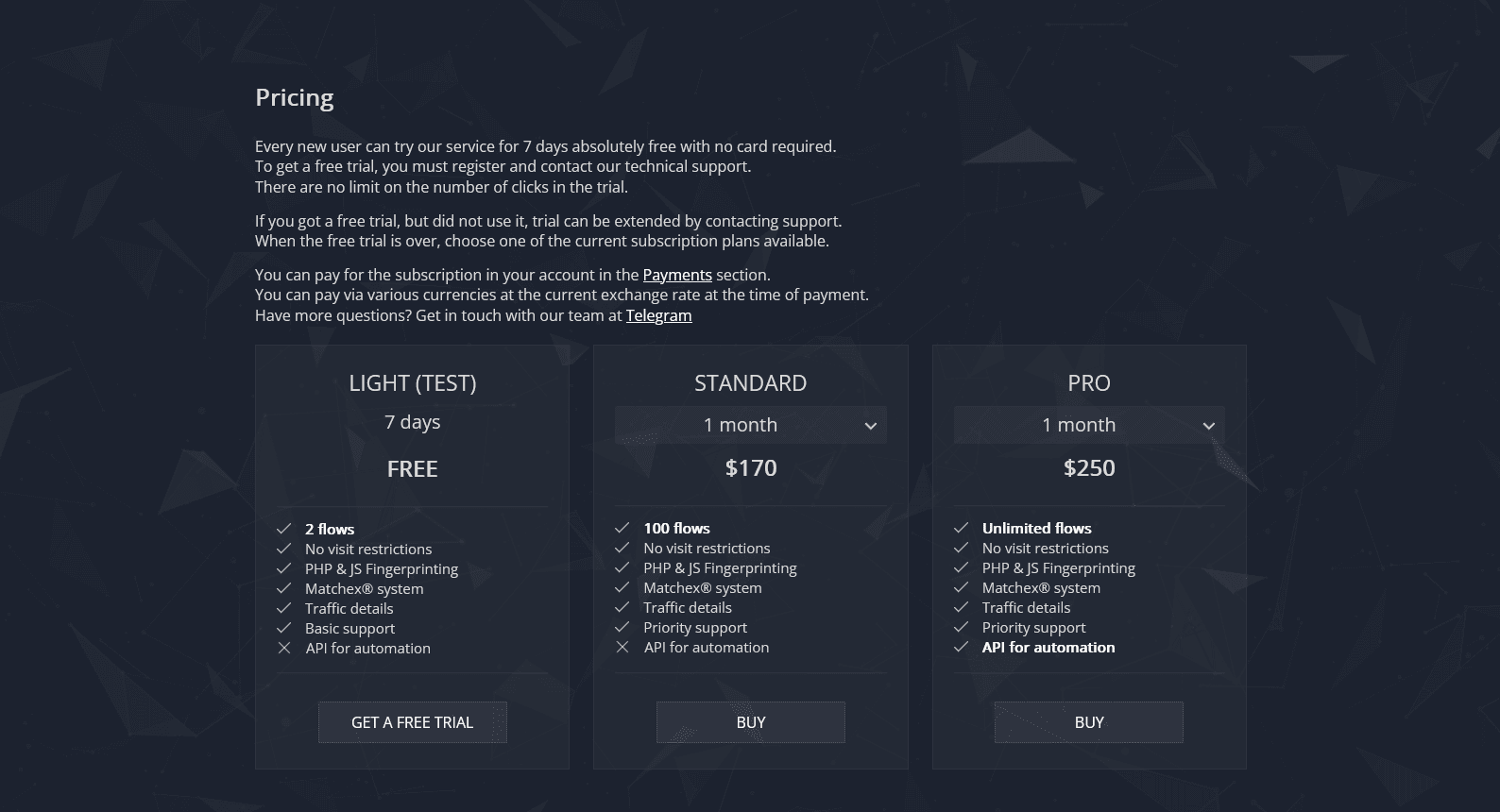
The pricing structure includes three plans:
- Test — 7-day free access with 2 flows
- Standard — $170 per month with up to 100 active flows
- Pro — $250 per month with unlimited flows and API access
There are also discounts available for longer subscription periods.
Infrastructure for Stable Campaign Launches
In addition to creatives and traffic filtering, infrastructure plays a critical role. Even with proper cloaking, weak setup elements can reduce platform trust and increase the risk of rejection or bans.
Key components to focus on:
- Anti-detect browser
Allows working with multiple accounts and keeping them isolated. High-quality fingerprinting reduces the risk of account linking and additional checks. - Proxies
Provide clean IP addresses and proper GEO alignment. Low-quality proxies can trigger suspicion and lead to restrictions. - Ad accounts
Aged and warmed-up accounts have higher trust. New or poorly prepared accounts are more likely to get restricted. - White page
Must comply with ad platform policies and look like a legitimate website. Weak or low-quality pages can still cause rejection. - Affiliate offer
Reliable partners and stable offers reduce complaints and additional checks. Low-quality offers often lead to issues.
In practice, it is the combination of all these elements together with cloaking that allows campaigns to run more consistently and reduces rejection rates.
Conclusion
If ads are consistently getting rejected in Google Ads and Meta, it is almost never random. In most cases, the platform identifies issues within the overall setup: landing page, creatives, mismatch, technical signals, or account quality.
That’s why ad rejections, account bans, and ongoing restrictions are especially common in restricted niches. Simple edits to ad copy or visuals are rarely enough.
To run campaigns consistently, a systematic approach is required. This includes proper creatives, high-quality proxies, and reliable traffic filtering. Within this setup, cloaking remains one of the core tools without which working in certain niches is simply not possible.